


With the business community still divided on the impact and direction of AI, the Forum’s Four Futures for Jobs in the New Economy: AI and Talent in 2030 report paints four possible scenarios for the future of jobs.
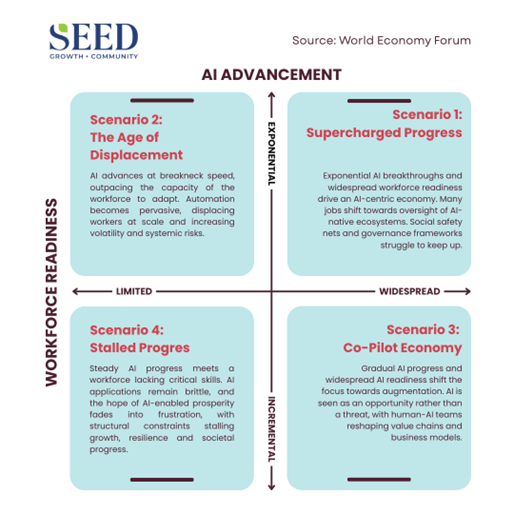
“Supercharged progress” sees AI boosting productivity and innovation, with workers shifting to new roles quickly, but social safety nets, ethics and governance lag.
In the “age of displacement” scenario, rapid tech advances outpace workers’ reskilling, causing talent shortages, increased automation, unemployment and social division.
The “co-pilot economy” features incremental AI growth, enhancing human expertise for a gradual business transformation.
Finally, “stalled progress” involves a mix of lagging workforce readiness and tech adoption, leading to uneven productivity gains and economic stagnation.
Why rewarding humanity remains key
The four AI impact scenarios emphasize a key point: the promise of AI can only be realized if people have the right skills.
AI is transforming digital skillsets, while wages for AI roles have increased by 27% since 2019, the World Economic Forum’s New Economy Skills: Building AI, Data and Digital Capabilities for Growth highlights. Yet businesses are struggling to recruit as workers are not acquiring AI skills at the required pace.
At the same time, another white paper, New Economy Skills: Unlocking the Human Advantage, points to the growing importance of human-centric skills such as creativity, innovation and adaptability. These are both the hardest to automate and valued by employers, but they are often invisible in the job market compared to AI technical skills. The issue stems from a lack of measurement and standards, which need to be addressed.
The true potential of the AI era depends on bridging the gap between rapid technological advancement and human-centric skills, ensuring that professional growth remains sustainable through a balance of digital proficiency and irreplaceable human creativity.”