


In a volatile business landscape, many executives still cling to the “business is war” mentality. However, according to strategy experts Adam M. Brandenburger (Harvard) and Barry J. Nalebuff (Yale), an exclusive focus on competition can be a fatal flaw.
Drawing on the principles of Game Theory, this article explores how to reshape your strategic foundation to not only survive but to actively lead the market.
1. THE “CO-OPETITION” MINDSET: COMBINING COMPETITION AND COOPERATION
Business is not a zero-sum game. Companies can achieve spectacular success without requiring their rivals to fail. The concept of Co-opetition encourages businesses to seek Win-Win opportunities where value is created through cooperation and captured through competition.
The GM Credit Card Case:
Instead of direct price cuts, General Motors (GM) launched a credit card that allowed users to accumulate points toward buying a new car. This move captured market share from rivals but also created “breathing room” for competitors like Ford to raise their own prices. Consequently, both giants maintained high profit margins rather than spiraling into a “lose-lose” price war.
2. THE VALUE NET: A STRATEGIC MAP
To change the game, you must first see the big picture. The authors propose the Value Net model to identify the four types of players that interact with a company:
The Value Net is defined by two primary dimensions:
The Vertical Dimension: Customers and Suppliers
- Resources (labor, raw materials) flow from suppliers to the company; products and services flow from the company to customers. Money flows in the opposite direction.
- Relationship: A mix of cooperation (to create value) and competition (to divide that value).
The Horizontal Dimension: Substitutors and Complementors
These players interact with the company without direct transactions.
- Substitutors: Players from whom customers can buy alternative products, or to whom suppliers can sell resources instead of selling to you.
- Strategic Insight: Using this term instead of “competitors” helps managers avoid adversarial bias and recognize the true nature of the market.
- Example: Coca-Cola and Tyson Foods are substitutors in the eyes of $CO_2$ suppliers (one uses it for carbonation, the other for flash-freezing).
- Complementors: Players who provide products or services that increase the value of your offering to customers or make it easier for suppliers to sell to you.
- Strategic Insight: This is the most often overlooked piece in traditional strategic analysis.
- Example: Rival airlines (like American and United) become complementors when jointly ordering new aircraft, helping the manufacturer offset design costs and lower the unit price for everyone.
Key Properties of the Value Net
- Multiple Roles: Roles are not fixed. An entity can simultaneously be a customer, supplier, substitutor, or complementor.
- Symmetry: The Value Net reveals fundamental symmetries between customers/suppliers and substitutors/complementors. Any strategy applied to one group often has a “mirror image” applicable to its symmetric counterpart.
3. THE “PARTS” FRAMEWORK: 5 LEVERS TO CHANGE THE GAME
To actively intervene and reshape the business game, you must influence one or more of the PARTS variables:
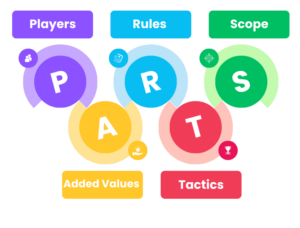
P – Players: Changing the Participants
In Game Theory, the list of players is never fixed. Sometimes, inviting a new competitor or supplier can entirely shift the bargaining power.
Case Study: Softsoap
- Context: Softsoap launched the first pump-dispenser liquid soap. They knew giants like P&G would quickly copy them as the product was unpatentable.
- Problem: Immediate entry by large rivals would crush Softsoap through superior distribution and brand power.
- Action: Softsoap secretly pre-ordered and cornered the entire global supply of plastic pumps for an entire year.
- Result: They effectively “locked out” major players from the point of production, gaining a 12-18 month head start to build their brand.
A – Added Values: Capturing Power
Added value is what you bring to the game. The rule is simple: You cannot capture more than you contribute. Therefore, the strategy is to increase your added value or decrease the added value of others.
Case Study: Nintendo
- Context: During its heyday, Nintendo faced pressure from retail giants (Walmart) and content owners (Disney, Marvel).
- Problem: Over-dependence on third-party retailers or IPs would erode Nintendo’s margins.
- Action: Nintendo strictly limited the supply of consoles to create artificial scarcity and developed its own exclusive characters like Mario.
- Result: Scarcity shifted power away from Walmart (who needed the stock more than Nintendo needed the shelf space). Owning Mario eliminated expensive licensing fees, keeping profits entirely within Nintendo.
R – Rules: Establishing Beneficial Regulations
Business games operate under rules (contracts, laws, or industry customs). Changing a single rule can shift the profits of an entire industry.
Case Study: Industrial Gases ($CO_2$)
- Context: This is a commodity industry where customers easily switch suppliers for lower prices.
- Problem: Constant undercutting led to a “race to the bottom” price war.
- Action: Suppliers introduced “Meet-the-Competition Clauses” (MCC) in contracts, granting them the right to match any lower price offered by a newcomer to keep the customer.
- Result: Potential entrants realized that even with lower prices, they couldn’t win customers. This rule effectively ended price wars and stabilized industry profits.
T – Tactics: Shaping Perceptions
In business, “perception is reality.” Tactics are moves made to shape how other players perceive the game, thereby influencing their behavior.
Case Study: Rupert Murdoch
- Context: Murdoch raised the New York Post price to 50 cents, but the Daily News stayed at 40 cents. The Daily News mistakenly believed they were winning on content, unaware customers were leaving the Post purely for price.
- Problem: If Murdoch simply lowered his price back to 40 cents, both would be trapped in a low-profit stalemate.
- Action: Murdoch signaled a drastic price drop to 25 cents (a loss-making level for both) and ran a trial in Staten Island to prove his “destructive” capability.
- Result: This tactic “cleared the fog.” The Daily News realized their customers were price-sensitive and raised their own price to 50 cents to avoid mutual destruction. Both papers became profitable.
S – Scope: Expanding or Contracting Boundaries
No game exists in isolation. Games are linked across space and time. Recognizing and changing the scope creates long-term strategic advantages.
Case Study: Sega vs. Nintendo
- Context: Sega launched a 16-bit console to attack the market. Nintendo was still highly successful with its older 8-bit system.
- Problem: If Nintendo launched its 16-bit system immediately, it would cannibalize its own 8-bit “cash cow.”
- Action: Nintendo allowed Sega a short-term monopoly in the 16-bit market by delaying its own product launch.
- Result: By staying out, Nintendo kept 16-bit prices high, which in turn protected the value of the 8-bit market. They maximized profit from the old technology before managing a controlled transition to the new.
4. THE TRAPS OF STRATEGY
To master the game, managers must overcome five common psychological and strategic traps:
1. The Game Taker Trap:
Assuming you must play the game as it is. Real breakthroughs come to “Game Makers” who change the rules.
2. The Win-Lose Trap:
Believing your success requires someone else’s failure. Co-opetition—seeking overlapping interests with rivals—is the key to sustainability.
3. The Uniqueness Trap:
Believing a strategy is only valuable if it’s uncopyable. Sometimes, having a rival imitate a healthy move (like raising prices) benefits the entire industry.
4. The Limited View Trap:
Failing to see the whole Value Net. Ignoring Complementors is a major blind spot that limits your strategic arsenal.
5. The Egocentrism Trap:
Seeing the game only from your perspective. Success requires Allocentrism—placing yourself in the shoes of other players to understand their logic and goals.
CONCLUSION
In business, there is no “silver bullet” for eternal victory. Changing the game is a continuous process. A great leader is not just a skilled player within an old set of rules, but a strategist who knows how to design the “right game” for their enterprise.
Source: Harvard Business Review