


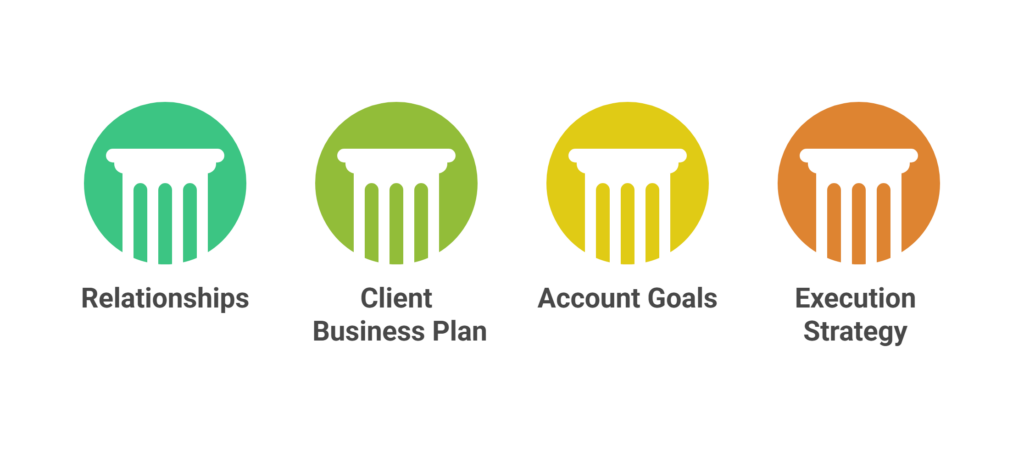
There are four key pillars of any account management strategy. These are:
- As the basis of any strategic business partnership, growing your relationship with the client should take center stage.
- The client’s business plan. Your client’s business objectives and strategies for growth should be at the heart of your account management plan.
- Your goals for the account. A client is identified as “key” because you have lofty goals for what can be achieved. Here is where you attempt to determine the future value of the account.
- Your strategy. Now you get down to business and describe what it will take to achieve those lofty goals.
1. Relationships
Just as building relationships is the backbone of account management, strategically mapping them out is the basis of account management strategy.
To begin, outline each customer stakeholder. These are the people that will make or break your plans for the customer. If you build and maintain relationships with them, your business should proceed smoothly. However, if they are neglected, these are the same people that may derail your future plans due to a lack of trust.
Take note of at least four critical characteristics for each stakeholder:
- The person’s title
- Their role in decision making
- The amount of contact you’ve had
- How receptive they are to your business relationship
Don’t be afraid to try various outreach and relationship building techniques on your key account contacts. Becoming a close contact, and even an extended part of your client’s team, means communicating and interacting with them in the manner that best suits their workflows.
2. Client Business Plan
One of the essential components of strategic account management is unearthing mutually beneficial business opportunities. And to know what is best for your client, you must know their business inside and out.
A simple way to begin this process is by creating a SWOT analysis, which outlines a company’s strengths, weaknesses, opportunities, and threats. But while a SWOT analysis is a fine start, a deeper level of research is required for your key accounts.
While you don’t necessarily need to see their complete business plan, it’s helpful to interview your clients about the inner-workings of their company. Who are their most important clients? How do they make money? What is their messaging and marketing strategy? What are their long term goals?
All of this information will help you tailor your account management strategy to your clients’ needs, which helps to embed your service or product as a must-have solution.
3. Account Goals
Begin with how much the business is currently worth to you and how much you believe it could be worth. Account for everything related to potential won or lost revenue, including missed opportunities and promising prospects.
Once you have established your goals for an account, outline a plan to achieve your objectives. The outline should focus on short, medium, and long-term goals, establishing a clear owner for each.
When this is completed, you will have established a roadmap for achieving long-term goals with a strategic customer. From here, you can periodically check in with those responsible for each part of the roadmap, and pivot your approach as needed.
4. Execution Strategy
While each of the first three fundamentals are essential to your account management plan, the final aspect, your strategy, is the most vital.
Now that you have established your account management framework, it is time to break down how your team can execute the plan. This is the most critical point of the account management process.
Break your account management strategy into SMART goals with short, medium, and long-term action plans.
To ensure that people stay accountable, be specific about what needs to be done and who has ownership. No matter how good your plan sounds in a meeting room or on a Zoom call, your efforts can be wasted entirely without clear direction and a system of accountability.
To execute your account management strategy, a variety of objectives will have to be managed. The KAM in charge must be a leader with exceptional account management skills, and an ability to keep team members and stakeholders aligned at all times.
Now that we’ve talked about a standard account management framework, let’s look at some best practices.
Source: Mindmanager