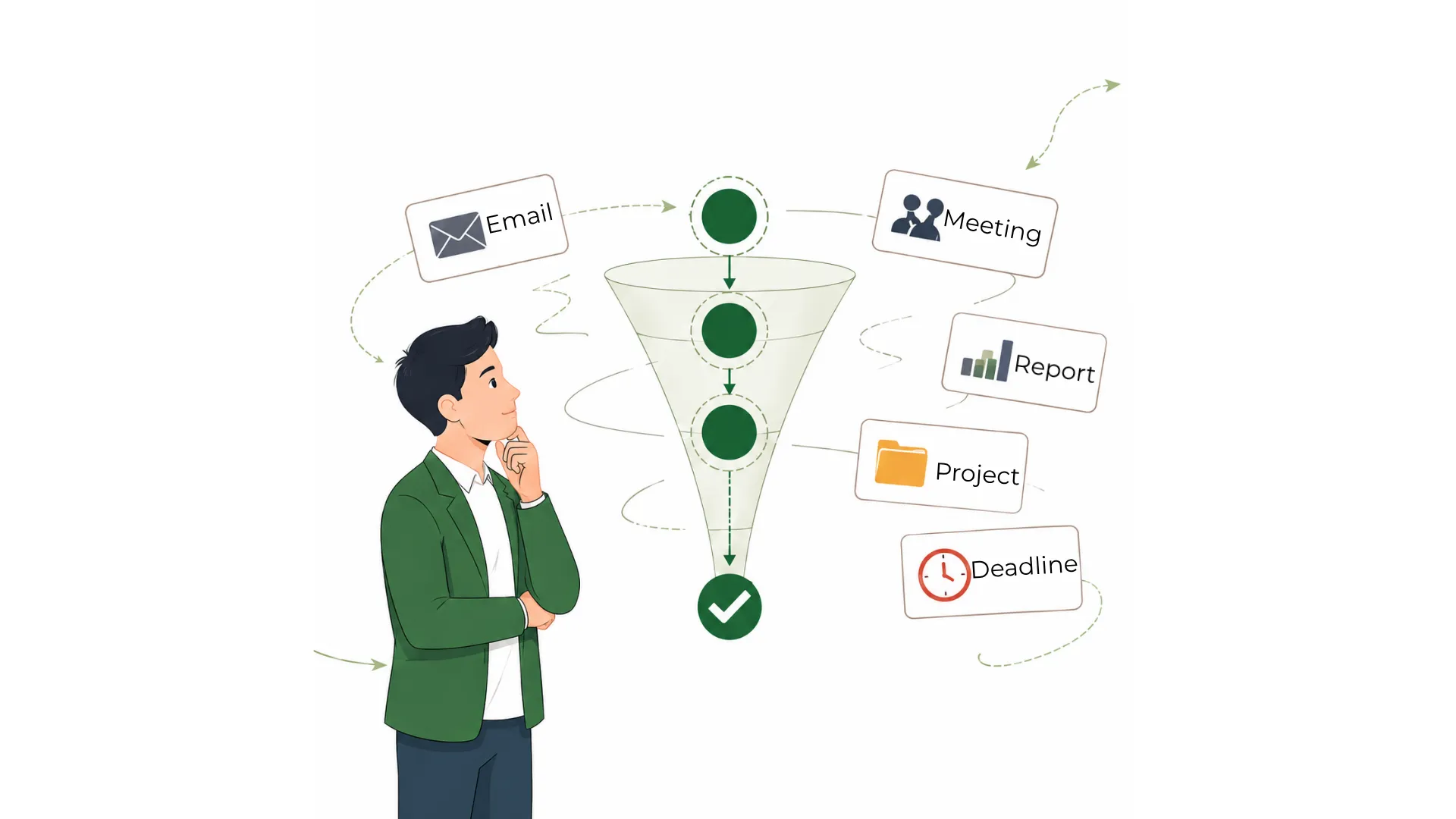


Leadership direction and practical principles to help managers rethink their approach, redesign systems, and develop teams in the AI era.
Investment in AI does not automatically create value. The gap between technology deployment and business outcomes often stems from leadership, accountability, and the way work is organized. When AI processes information faster but decision rights, data quality, and control mechanisms remain unchanged, organizations may simply accelerate existing weaknesses. For managers, the critical question is no longer, “Has the team adopted AI?” but rather, “Have we changed how we work so that AI delivers measurable, verifiable value?”
1. From Delegating Tasks to Tools to Owning the Direction
AI should serve as a thinking partner, not as a substitute for leadership accountability. It can synthesize data, propose options, and draft content; people must still define objectives, weigh trade-offs, and remain accountable for decisions. Managers need to shift from controlling every action to clarifying expected outcomes, quality standards, and acceptable boundaries. A manager’s value lies in the quality of their questions and judgment, not merely in the speed at which answers are produced.
Practical recommendation: Before undertaking any AI-enabled task, clearly define the business problem, relevant context, permitted data, output criteria, and final decision owner. When reviewing recommendations, require assumptions, limitations, and alternative options to be stated explicitly rather than seeking confirmation of a predetermined view. Do not mistake a coherent response for a sound decision.
2. From Procedural Approval to Empowered Oversight
Automation bias is the tendency to trust and accept automated recommendations without sufficient independent evaluation. Simply placing a person in the process does not guarantee effective control. If reviewers lack the time, information, or authority to challenge an output, approval can quickly become a formality. Leadership in the AI era therefore requires designing conditions in which people can genuinely examine, correct, or stop system outputs.
Practical recommendation: Classify tasks by risk level and define which outputs require mandatory review before use. Reviewers should understand the data sources, tool limitations, and escalation path when concerns arise. Track modifications, rejections, and errors identified after approval. A near-zero challenge rate should be treated as a signal to assess the quality of oversight, not as automatic evidence that the system is flawless.
3. From Adding AI to Existing Processes to Designing Human–AI Teams
Managers are increasingly coordinating both people and AI agents. However, “coaching” these two groups is fundamentally different: people need feedback, development opportunities, and a safe environment in which to experiment; agents need clear instructions, appropriate data, the right access permissions, and iterative testing loops. When AI produces weak outputs, managers should first examine task design, context, and integration before concluding that the tool is ineffective. Automating one step does not resolve a bottleneck that sits in a downstream handoff.
Practical recommendation: Redesign one process end to end, making clear where AI provides support, where people retain decision authority, and where quality controls apply. Pilot on a limited scale, document errors, and refine the instructions or data accordingly. Measure review and rework time as well as drafting time. Scale only when improvement at one stage delivers a genuine benefit across the full process.
4. From Driving Speed to Enabling Learning and Sense-Making
AI is changing work faster than many organizations can adapt. A manager’s sense-making capability is the ability to explain what is changing, why the change is necessary, and which standards must remain non-negotiable. Leaders must balance speed with prudent oversight: they should create space for experimentation and learning without using “we are still testing” as a reason to overlook risk. A learning culture must become part of the operating rhythm rather than a one-off training program.
Practical recommendation: Before a pilot begins, align on the calibration period, success criteria, and stop conditions. After each cycle, review which assumptions proved incorrect, whether issues arose from data or process design, and which lessons should be incorporated into shared guidance. Give teams time to practice validating outputs, share use cases, and raise concerns without being penalized for challenging AI-generated recommendations.
5. From Policies on Paper to Everyday Governance
The AFPTS framework encompasses accountability, fairness, privacy, transparency, and sustainability. For managers, the imperative is to translate these principles into operating rules: who owns the system, which data may be used, how outputs are validated, and who has the authority to stop deployment or use. Governance should not be separated from business objectives; it helps contain errors, protect trust, and manage the cost of AI adoption.
Practical recommendation: Maintain an inventory of tools and use cases, assign accountable owners, define data permissions, and preserve an audit trail of significant decisions. Engage technology, legal, or risk governance teams where appropriate. Track outcomes through a balanced set of measures, including processing time, output quality, rework volume, incidents, and cost. Do not equate AI usage volumes with value creation.
Conclusion: Principles for Turning Mindset into Action
AI transformation does not need to begin with a large-scale plan or a fixed timeline. It begins with principles applied consistently. Start with the problem, not the tool: identify a real business need and define the outcome to be improved. Test small and learn quickly: limit the scope, validate assumptions, and refine the approach before scaling. Align decision rights with accountability: clarify who executes, who reviews, and who has the authority to stop. Measure value, not adoption: assess quality, time, cost, and risk across the full process. Turn lessons into shared capability: update guidance, share experience, and sustain feedback in day-to-day work. Scale only after outcomes have been validated and the team has demonstrated the ability to maintain control.
Leadership in the AI era is not about knowing the greatest number of tools. It is about creating a system in which people and technology complement one another responsibly. Managers must retain ownership of direction, empower those responsible for oversight, redesign workflows, and sustain learning loops. AI can accelerate execution; the quality of leadership determines whether that speed creates value or simply enables the organization to make mistakes faster.